
Few regions in Indonesia are surrounded by as many fixed ideas as Tana Toraja. Some people call it the “land of the dead.” Others know it for multi-day funeral ceremonies, tau tau statues looking out from rock cliffs, or videos of the Ma’Nene’ ritual, when families remove the bodies of relatives from their tombs, clean them, and dress them in new clothes.
Because of this, Torajan funeral culture is often described as one of the strangest in the world.
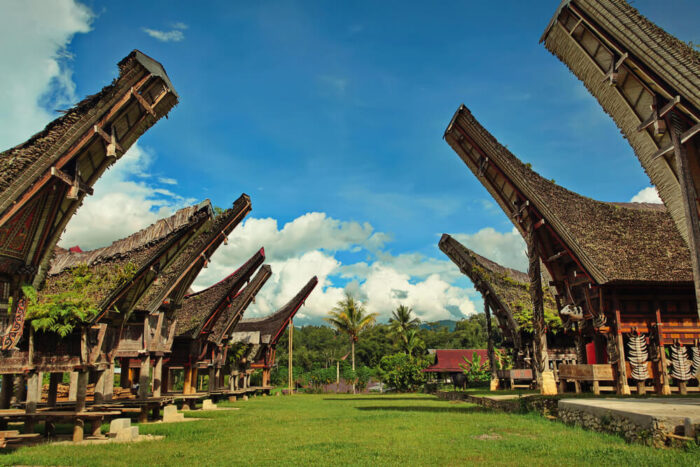
But this picture is too simplified. Funeral rituals are one of the most visible parts of Torajan culture, but they are only one part of a much bigger system of traditions, beliefs, and family ties.
To understand why funerals can last several days, or why a deceased relative may stay at home for many months, it helps to first understand how Torajans see life, family, and the world of their ancestors.
In Tana Toraja, death is not always seen as an immediate end, but as a gradual transition to another world. A funeral is not only a farewell to the deceased.
It is also one of the most important social events for the family, when relatives gather, relationships are strengthened, and the position of each family group is publicly reaffirmed. This view has roots in the traditional religion of Aluk To Dolo, many parts of which still shape local culture today, even though most Torajans now follow Christianity.
What Does Tana Toraja Actually Mean?
One common mistake is using the name Tana Toraja to describe the people themselves or their culture. In fact, it is first of all a geographical name.
The word tana means “land” in the Torajan language, while Toraja refers to the ethnic group. Tana Toraja therefore literally means “Land of the Torajans”.
Today, it is also the name of one of Indonesia’s regencies in South Sulawesi. In 2008, the original administrative area was divided into two parts: Tana Toraja and Toraja Utara, or North Toraja.
Traveling to Tana Toraja? Learn more in our detailed guide Tana Toraja Guide: Villages, Funerals & Travel Tips.
The Torajans are one of many ethnic groups on the island of Sulawesi. Their homeland lies in the mountainous interior of the southern part of the island, an area that stayed relatively isolated from coastal trading centers for centuries.
That isolation helped preserve many traditions that gradually disappeared elsewhere in Indonesia.
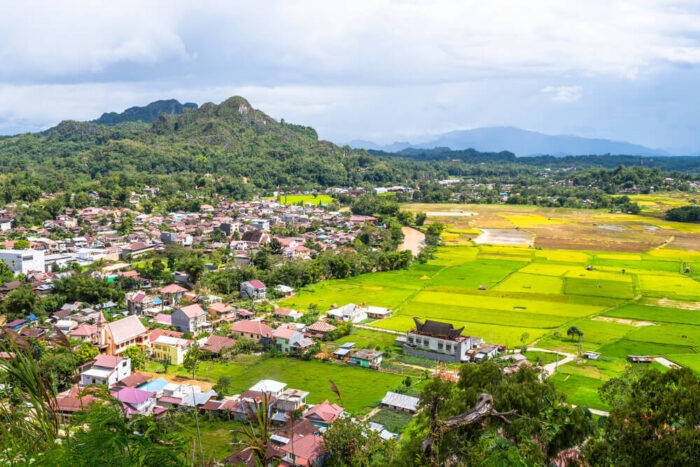
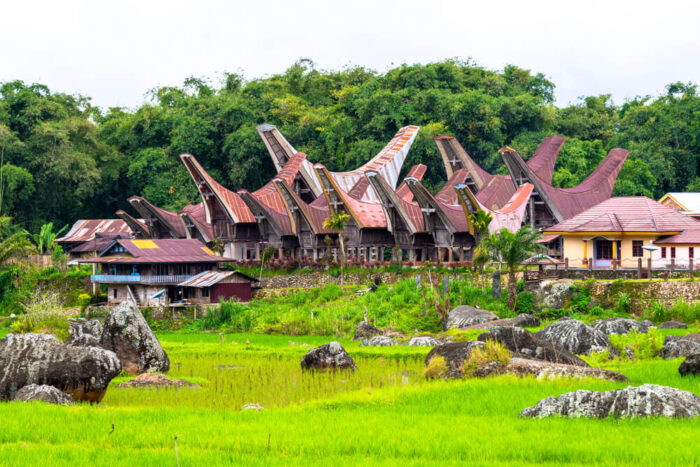
An important part of Torajan society has always been the ancestral house known as the tongkonan. These houses were not only places to live. They also represented the identity of an entire family line.
Belonging to a particular tongkonan shaped family relationships, social status, and the responsibilities of different family members. Many important ceremonies still take place around these houses today.
Most Torajans now live modern lives, study, work, and use the same technologies as people in other parts of Indonesia. Traditional ceremonies remain an important part of their identity, but they are not everyday life.
Between Aluk To Dolo and Christianity
For centuries, the Torajans followed a religious system known as Aluk To Dolo, which can be loosely translated as the “way of the ancestors” or the “teachings of the ancestors.”
It was not only a religion in the modern sense, but also a set of rules that shaped almost every part of life, from agriculture and house construction to weddings and funerals. According to local tradition, this order was given to people by the gods, and following it was meant to keep balance between humans, nature, and the ancestors.
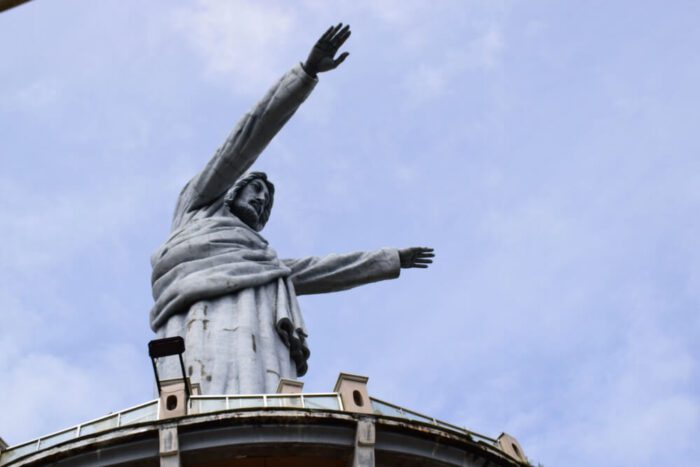
During the second half of the 20th century, most Torajans converted to Christianity, mainly through the influence of Dutch missionaries. But accepting a new religion did not mean leaving older customs behind.
Because of this, it is common for a funeral to begin with a Christian service and continue with rituals that go back deep into the pre-Christian past. Many of these ceremonies still survive today, often in forms that fit both Christianity and modern life.
This mix of tradition and newer religious practice is one of the most distinctive parts of Torajan culture today.
The Torajan view of death is also very different from what many foreign visitors are used to. In many Western societies, death is seen as the moment a person is permanently gone.
In the traditional Torajan view, it is more of a gradual process. Until a proper funeral has taken place, the deceased is not considered truly dead.
Families may still speak about the person as if they were ill or resting. Because of this, the body may remain at home for several months, or sometimes even years, until the family can prepare a proper funeral.
The main reason is the scale of the preparation. A funeral is one of the biggest events in the life of the whole family.
Organizing it requires significant money because relatives may travel back from all over Indonesia and from abroad, and the ceremony includes a feast as well as the traditional sacrifice of buffaloes and pigs. Families often save for a long time or wait until all close relatives are able to return home.
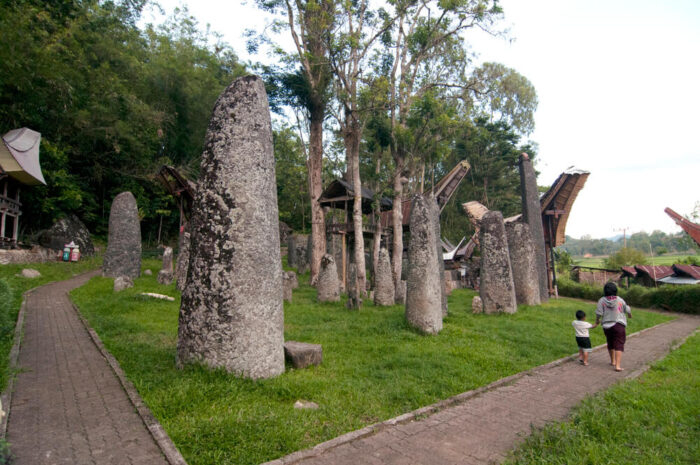
Although the Torajans are best known for funeral ceremonies, their culture is not built only around death. Celebrations connected with life matter just as much, including weddings, the building of ancestral houses, and other major family events.
These ceremonies are a reminder that Torajan culture is deeply rooted in family, relationships, and respect for ancestors.
Traditions You May Encounter in Tana Toraja
If you travel to Tana Toraja, there is a real chance you may come across a traditional ceremony during your trip.
Local people are often very welcoming to visitors, and foreigners are invited to many ceremonies. Still, it is important to remember that these are not tourist shows, but important family events with deep spiritual and social meaning.
Makassar is the main gateway to Tana Toraja, but it’s also worth exploring on its own. Learn more in Things to Do in Makassar, Indonesia: A Practical Guide.
Funeral Ceremonies
The most important ceremony is the traditional funeral, which may last for several days and be attended by hundreds or sometimes thousands of people. For Torajans, it is one of the biggest events in the life of the whole family.
The funeral includes prayers, music, ceremonial processions, feasts, and the exchange of gifts between different family groups. Every gift is carefully recorded because the same generosity is expected to be returned in the future.
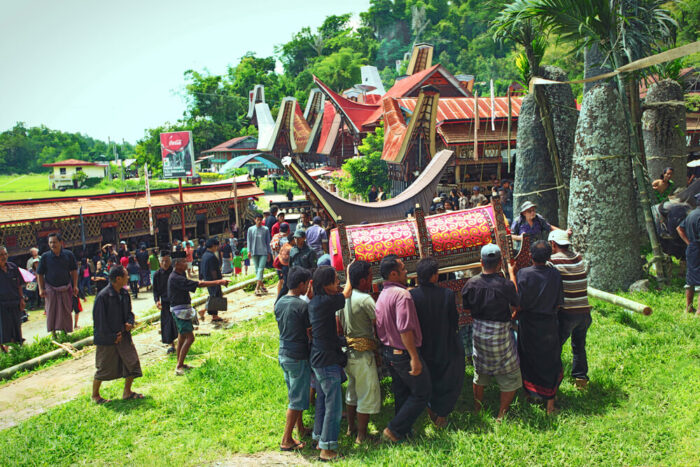
These gifts are not charity. They are part of a system of mutual obligations between families and family groups.
When another family holds a funeral in the future, a similar level of generosity is expected in return. So the funeral is not only a farewell to the deceased, but also a public confirmation of family and social ties.
For many visitors, the sacrifice of water buffaloes and pigs is the hardest part to witness. For Torajans, however, this is not simply a dramatic spectacle.
In the traditional belief system, the buffalo helped the deceased on their journey to the world of the ancestors. It also remains a symbol of prestige and family importance. The more important the person was, the more animals may be sacrificed during the funeral.
Backindo Tip: Animal sacrifice is not unique to Tana Toraja within Indonesia. Similar traditions can also be found on the island of Sumba, where they are part of funeral ceremonies and other important celebrations.
Rock Tombs and Tau Tau Statues
After the funeral is over, the deceased is placed in their final resting place. In Tana Toraja, this usually does not mean a standard cemetery, but a tomb carved into a rock cliff or a natural cave.
Some coffins are suspended high on cliffs, while others are placed inside large rock chambers.
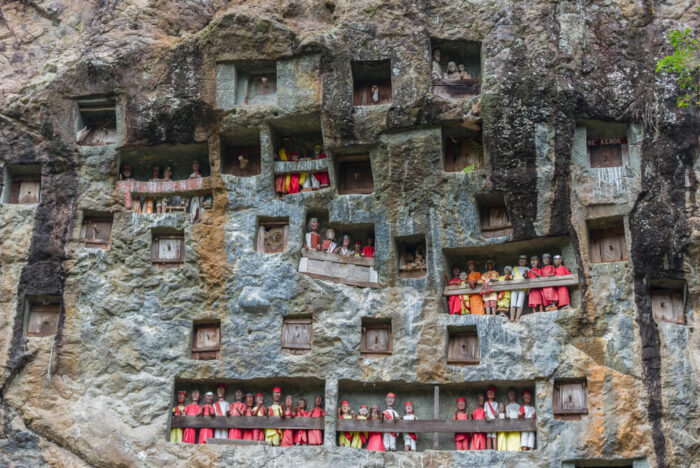
In front of many tombs stand wooden statues known as tau tau. These figures represent the deceased and symbolically watch over their descendants and homeland.
Their purpose is not to worship the dead, but to show their continuing presence and connection with the family. In the past, tau tau were mainly reserved for people from higher social classes. Today, they can be seen at several historic burial sites, including Lemo and Londa.
Celebrations of Life
Although most visitors travel to Tana Toraja because of its funeral ceremonies, local culture also includes many celebrations of life. These are held for weddings, the completion of a new tongkonan ancestral house, and other important family events.
If you are in the right place at the right time, you may be invited to one of these celebrations, just as you might be invited to a funeral. For foreign visitors, they offer a chance to see Torajan culture from a different angle, not only through its relationship with death, but also through family, tradition, and everyday life.
Ma’Nene’
In recent years, the Ma’Nene’ ritual has received a lot of attention in international media and is often described as the “festival of the dead.”
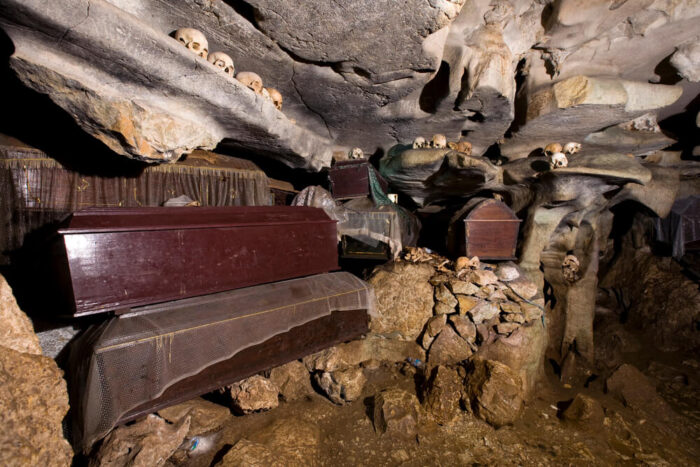
In reality, it has a much deeper meaning. During the ritual, families open the tombs of their ancestors, carefully remove the bodies, clean them, dress them in new clothes, and spend some time together with them.
It is not meant as a spectacle or an act of disrespect, but as a way to symbolically maintain a relationship with those who have passed away.
It is also important to know that Ma’Nene’ is not an everyday tourist attraction. It only takes place in certain villages and during specific periods of the year. If you would like to see it, it is worth checking current dates in advance or planning your visit with a local guide.
How to Behave When You Encounter a Ritual
If you come across a funeral or another celebration during your stay in Tana Toraja, it is not unusual for local people to invite you in. Torajans are generally very hospitable, and foreign visitors are often welcome.
Even so, remember that you are a guest at an important family event, not at a tourist attraction.
Dress modestly. Formal clothing is not necessary, but avoid very short shorts or clothes that are too revealing. Long trousers or a longer skirt and a shirt that covers the shoulders are usually the most appropriate choice.
Because animals may be slaughtered during the ceremony, closed shoes are a better option.
Photography is usually allowed, but it is always better to ask first or follow the instructions of local people. Moments involving the close family of the deceased or the religious part of the ceremony may be especially sensitive.
At some funerals, it is customary to bring the family a small gift, such as a carton of cigarettes or a financial contribution. But this is usually not expected from ordinary tourists, especially if they only attend briefly.
If you are invited by a local guide or directly by one of the families, it is a good idea to ask in advance whether a gift is appropriate.
Why This Matters When You Visit Tana Toraja
Tana Toraja is one of the places that shows how differently people can understand life and death. Torajans do not live only for funerals, but death is treated as a natural part of life and given far more attention than many foreign visitors are used to.
If you travel through Tana Toraja, it is worth slowing down and trying to understand more than just the visual side of the ceremonies. It is also a chance to experience local hospitality and see that behind each ritual is the story of a real family, along with a way of thinking that has been shaped over generations.
Tana Toraja is not a living museum. It is a modern region whose traditions continue to evolve, and many of the sensational stories shared about it are still simplified or taken out of context.
If you want the broader planning side as well, continue with our Tana Toraja guide, see how to get from Makassar to Tana Toraja, or explore the wider South Sulawesi travel guide.
Bonus Tip: Where to Stay in Tana Toraja
Rantepao is the most practical base for exploring Tana Toraja. Most guides, restaurants and transport connections are here, and you can choose between inexpensive family-run homestays and larger hotels just outside town.
For a friendly, affordable stay, Toraja Sanggalangi Homestay and The Singki Home Family are both good options. They are simple rather than hotel-style stays, but work well if you prefer a smaller place with local hosts.
If you’d rather stay outside the busy center, Bait Lino is a more peaceful option in the hills around Rantepao, with bungalows, greenery and a swimming pool.
For more comfort, Toraja Misiliana Hotel is worth considering. It sits just outside Rantepao and has a swimming pool, restaurant and more of a traditional hotel setup, which can be nice after long days exploring the region.