
Marapu is the traditional belief system of the Sumbanese people. It shapes how many families think about ancestors, death, the house, the land, and major ceremonies. Even though most people in Sumba officially identify as Christian today, Marapu still remains an important part of local culture and everyday life.
When you arrive in Sumba, you quickly notice how different it feels from many better-known Indonesian islands. Tall traditional houses, buffalo horns displayed on walls, and stone tombs standing in the middle of villages are not just visual symbols. They are closely connected to Marapu and to the way local communities understand family, status, and their relationship with ancestors.

Marapu is sometimes described as an animist religion or an ancestral belief system. That is partly true, but it is also a bit too simple. For many Sumbanese families, Marapu is not just about rituals. It is a broader cultural and spiritual framework that helps define obligations to family, the treatment of the dead, the meaning of ceremonies, and the balance between the living and the ancestors.
If you want to understand Sumba beyond beaches and viewpoints, understanding Marapu helps a lot.
What Is Marapu
In simple terms, Marapu in Sumba is a traditional ancestral belief system. It is based on the idea that life does not fully end with death and that ancestors remain present in the world of the living. They can protect, guide, warn, or punish when important obligations are ignored.
This is why Marapu is closely tied to rituals, family lineage, sacred houses, stone tombs, and the agricultural cycle. It is not just a private belief. It is woven into community life and into the way families understand their responsibilities to each other and to those who came before them.
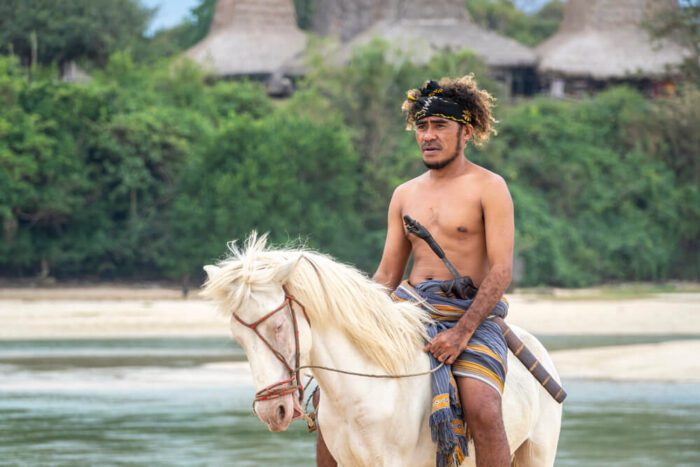
Traditional Marapu cosmology also works with several levels of existence: the spiritual realm above, the human world in the middle, and the realm of the dead below. This is not only an abstract idea. It influences how houses are built, how rituals are performed, and how people understand the correct order of life.
The highest creative force is usually seen as distant, so everyday communication happens mainly through ancestors. A person is strongly connected to their clan and lineage, and this ancestral connection helps define who protects them and which rituals matter most to their family.
According to local tradition, the first ancestors descended from the sky and brought with them the rules that were meant to keep balance between the spiritual and human worlds. These stories still matter because they explain why adat (customary law), family lineage, and ritual obligations continue to carry so much weight in Sumba today.
Marapu therefore cannot really be separated from origin and continuity. In this worldview, a person is not just an individual. They are part of a longer family story that must be maintained and respected.
Traveling to Sumba with children? Here you’ll find practical tips: Traveling Sumba with Kids: Tips from an Expat Mom.
Where Marapu Is Visible in Everyday Life
One of the clearest visible symbols is the traditional Sumbanese house. For travelers, it may look striking and photogenic. For local families, it is much more than that. It is a spiritual center of the clan, a place linked to ancestors, and a setting for important ceremonies and decisions.
In some parts of Sumba, you may also notice simple altars called katoda near houses, fields, or village entrances. They are often modest rather than decorative: a wooden structure, a few stones, and offerings such as betel nut, rice, or other symbolic items.

These offerings are connected to protection, health, harvests, and the relationship between people and the unseen world. The farming cycle is still closely linked to ritual timing in many communities.
Traditional ritual leaders, often called Rato, also play an important role. They are not priests in the Western sense, but respected figures who guide ceremonies and help maintain the correct connection between the community and the ancestors.
If you want to see how this looks in practice, the easiest places to start are still the island’s traditional villages in Sumba, where the layout of houses, tombs, and ritual spaces makes Marapu visible even without attending a ceremony.
Marapu and Christianity in Sumba Today
Today, the majority of people in Sumba officially identify as Christian, and churches are a normal part of both village and town life. But that does not mean Marapu has disappeared.
In reality, many families live with both layers at once. They may attend church services while also following ancestral customs, participating in traditional funerals, or observing rules connected to clan rituals. From the outside, this may look contradictory. Locally, it is often simply part of identity.
Some older practices connected to Marapu have weakened or nearly disappeared, while others remain deeply embedded because they are tied to funerals, marriage exchanges, village structure, or social status. This is why Marapu is still highly relevant even in modern Sumba.

That overlap between Christianity and Marapu is one of the most important things for visitors to understand. If you treat Marapu as a completely separate or vanished religion, you will miss how daily life in Sumba actually works.
Family status, lineage, and ceremonial obligations still matter a lot. You can see this especially during funerals, where the scale of the event, the number of animals sacrificed, and the size of the tomb often reflect the family’s social standing.
Important Marapu Rituals You May Hear About or Experience
Funerals
If one ceremony best explains the meaning of Marapu, it is the funeral. Death is not seen simply as an end, but as an important transition between the human world and the world of the ancestors. The family is responsible for making sure the deceased is properly guided into that next stage.
That is one reason why traditional funerals in Sumba can be expensive, logistically complex, and delayed for a long time. A family may wait until enough relatives, animals, money, and ceremonial preparations are in place. The construction of a stone tomb can also take significant time and collective effort.
In some cases, the body remains in the house for months or longer while the family prepares. During this transition, the deceased is not treated as fully separated from the household. Symbolic offerings such as rice or betel nut may still be presented.
The funeral itself is also a public expression of family status and obligation. Ceremonies often include speeches, exchanges, and animal sacrifice, especially buffaloes and pigs. The number of animals can reflect both social standing and the family’s ability to fulfill its responsibilities.
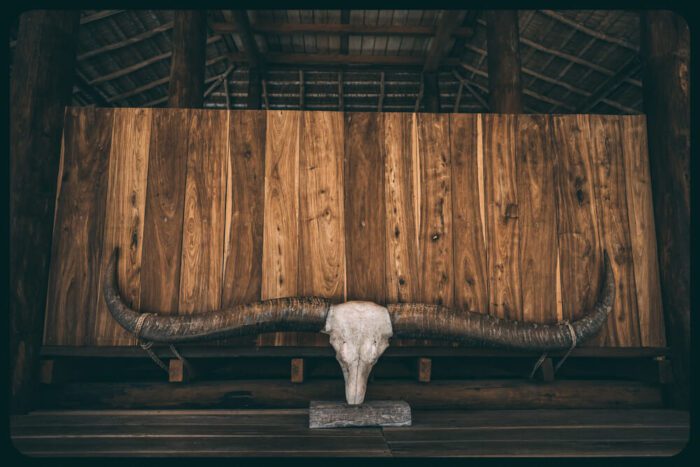
This is why you often see buffalo horns and pig jaws displayed on traditional houses. They are not trophies. They are a visible record of past ceremonies and of the family’s relationship to ancestors, obligation, and status.
For visitors, a funeral in Sumba can be a powerful but also confronting experience. Animal sacrifice is not performed as a spectacle. It is understood as a spiritual act tied to duty, communication with ancestors, and the social fabric of the community.
Planning the logistics first? Read How to Get to Sumba: Flights and Ferries.
The Traditional House as a Spiritual Center
A traditional Sumbanese house is not just a home. It is also a ritual space and a symbol of the connection between the spiritual realm, the human world, and the ancestors.
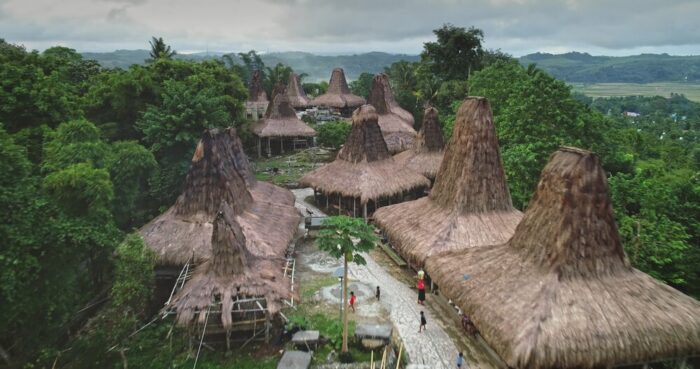
The tall roof rising upward symbolizes the connection to the upper world, while the living space below belongs to everyday family life. Sacred heirlooms and ritual objects may be kept in the house, and important family decisions are often linked to this space.
Building a house is therefore not only a practical project. It is also a ritual process, from selecting the site to raising the main structure. Without the proper ceremonies, the house would not be fully integrated into the ancestral order.
Want to see these houses in person? Start with 7 Traditional Villages in Sumba Worth a Visit.
Pasola and Pajura
Outside funerals, the best-known Marapu-linked ritual is Pasola, the ceremonial horseback battle held mainly in West and Southwest Sumba before the end of the rainy season.

Even though Pasola is now promoted as one of Sumba’s best-known cultural events, it is not just a performance for tourists. It is traditionally linked to fertility, agriculture, and the relationship between people, land, and ritual timing.
A related ritual expression is Pajura, a traditional fist fight between young men that may take place during larger ceremonies. Like Pasola, it is regulated and symbolic rather than a random personal conflict.
For dates, context, and what to expect, read Pasola Festival in Sumba: A Traveler’s Guide to the Tradition.
Reading Animal Entrails
Another traditional practice is reading the entrails of sacrificed animals, especially the liver of a chicken or pig. This is understood as a way of seeking answers about timing, success, health, harvests, or whether an offering has been accepted.
For outsiders, this can seem unfamiliar, but within Marapu it is part of how people interpret signs and make sense of important decisions. These moments usually happen in a smaller ritual setting rather than as something meant for public attention.

If you happen to witness a private ritual moment, the most important thing is respect. Not everything is meant to be photographed or fully explained to visitors.
How to Behave Respectfully if You Encounter a Ritual
Seeing Marapu in practice can be one of the most meaningful parts of a trip to Sumba, but it also requires sensitivity. A few basic rules help a lot:
- Do not treat rituals as entertainment. Even when they are visually striking, they are first of all family and community obligations.
- Ask before taking photos or videos. Permission is not automatic, especially during funerals or private rituals.
- Follow your local host, guide, or driver. They usually understand what is appropriate in that specific village or ceremony better than a generic internet guide ever could.
- Dress modestly. In villages or at ceremonies, covering shoulders and knees is the safer choice. If you are invited to an important event, wearing a woven cloth can also be appreciated. If you want to understand these textiles better, read Traditional Ikat Weaving in Sumba.
- Accept that you may not fully understand everything. Marapu is not just an exotic belief about spirits. It is part of family relationships, community structure, and local history.
A respectful attitude usually opens far more doors than curiosity without context.
Why Understanding Marapu Helps You Understand Sumba
Marapu helps explain why stone tombs stand inside villages, why traditional houses carry such importance, why some ceremonies involve major animal sacrifice, and why family obligations can shape travel timing in ways visitors do not always expect.
If you only see Sumba through beaches, hills, and viewpoints, you will still see a beautiful island. But if you also understand the role of ancestors, lineage, ritual, and obligation, the island starts to make much more sense.
That broader context is one of the reasons Sumba feels so different from many other destinations in Indonesia.
Continue reading: